Prayagraj, Uttar Pradesh, India

Triveni Sangam Prayagraj: Sacred Confluence Visitor & Planning Guide

An independent, visitor-first resource to help pilgrims, families, and first-time travelers navigate ghats, understand boat arrangements, and reach trusted local transport and puja facilitators.

Plan Your Visit WhatsApp: 8956975001
📍 Confluence of Ganga, Yamuna & Saraswati ⏱ Best visiting hours: Sunrise (5:30 AM – 8:30 AM)
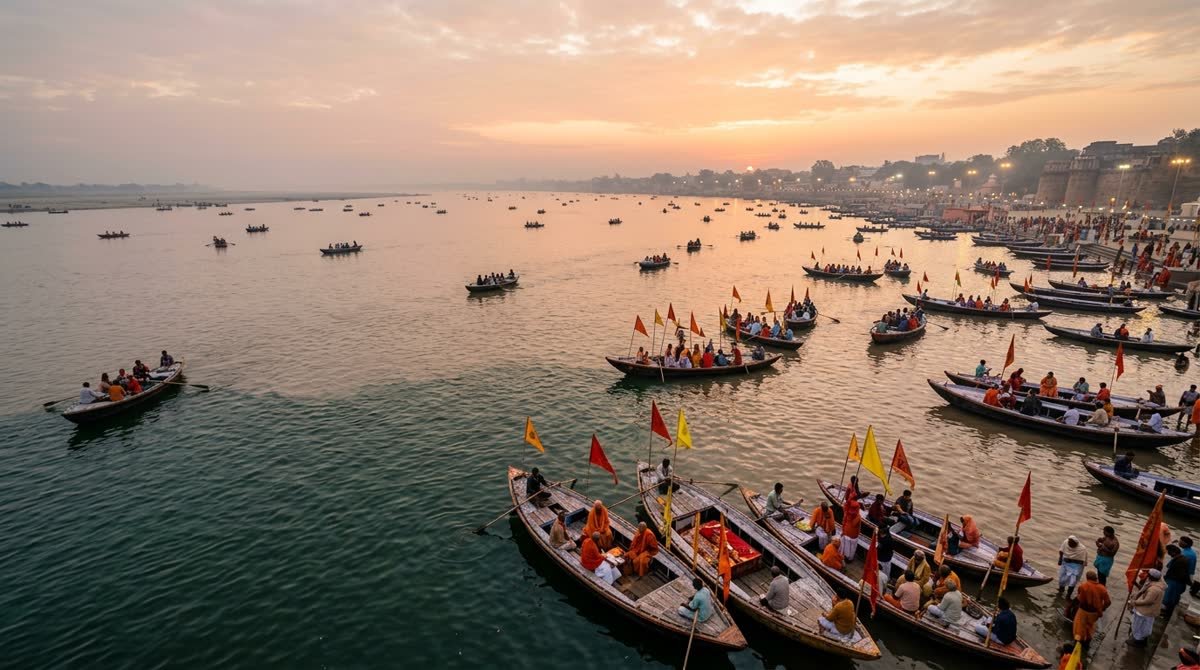
Triveni Sangam confluence at sunrise in Prayagraj

Sacred meeting point of pale Ganga and deep Yamuna waters at Prayagraj.

Essential Orientation

What Every Visitor Needs to Know Before Reaching Sangam

Unlike many river ghats where temple steps meet deep water directly, Triveni Sangam sits on a shifting riverbed. Here are the core operational facts to save you time and confusion.

01. The Bathing Point

The Confluence is Offshore

The exact Triveni junction is located in the middle of the river. To take snan right at the meeting point, pilgrims board wooden boats to moored bathing pontoons.

Explore boat ride guide →
02. Sand vs Paved Steps

Choosing the Right Ghat

Approaching from Qila Ghat requires walking over 500m to 1km of deep sand. For senior citizens, use Saraswati Ghat or Arail Ghat for paved ramps directly to boats.

Compare all 4 ghats →
03. Fares & Local Verification

Check Prices Locally

Boat fares are not fixed on a national ticket system and vary between regular weekdays, shared seat rates, and major festivals. Always agree on round-trip fare before boarding.

Verified local advisory · Check locally before travel
📅 Special Pilgrim Advisory · 2027 Calendar

Prayagraj Magh Mela 2027 & Kumbh Mela Cycle: What Devotees Must Know

Every year, thousands of pilgrims search for Kumbh Mela 2027 Prayagraj dates. Here is the unvarnished, authentic local fact-check: following the historic 2025 Maha Kumbh at Prayagraj, the next Ardh Kumbh at Prayagraj will occur in 2031. In 2027, the national Kumbh Mela gathering rotates to Haridwar (Ganga Ardh Kumbh) and Nashik-Trimbakeshwar (Godavari Simhastha).

However, right here at Triveni Sangam Prayagraj, the world-famous annual Magh Mela 2027 (Maha Kalpvas) takes place with identical spiritual sanctity, featuring millions of devotees, pontoon bridges, and six sacred royal bathing parvas.

First Amrit Snan Jan 14/15, 2027

Makar Sankranti

The Sun enters Uttarayan (Capricorn). Millions take dawn dips offering sesame (til), jaggery, and khichdi daan. Siberian migratory birds flock around pilgrim rowboats.

Kalpvas Vow Begins Full Moon · Jan 2027

Paush Purnima

Official commencement of the sacred 30-day Kalpvas vow. Over 100,000 sadhakas move into straw-thatched tents on the dry river sands to lead lives of austerities.

Peak Crowd
The Royal Bath New Moon · Feb 2027

Mauni Amavasya

The most auspicious bathing day of the entire year. Tradition prescribes taking a silent dip (maun snan) at dawn. Traffic on Bandh Road is strictly pedestrian-only.

Saraswati Jayanti 5th Lunar Day · Feb 2027

Basant Panchami

Devotees wear traditional yellow pitambar attire and offer yellow marigolds to the subterranean Saraswati River, invoking divine wisdom and spiritual illumination.

Sant & Guru Snan Full Moon · Feb 2027

Maghi Purnima

Marks the ceremonial conclusion of Kalpvas. Pilgrims perform Brahma Bhoj, donate blankets and food to Prayagwal purohits, and take final gratitude dips.

Mela Culmination Dark Fortnight · March 2027

Maha Shivratri

The grand finale of the winter mela season. Pilgrims carry consecrated Triveni water directly to Kashi Vishwanath in Varanasi and local Shiv temples like Mankameshwar.

ℹ️ Ground Realities & Local Logistics for 2027 Mela Months

Temporary Pontoon Bridges (Pipa Pul): Prayagraj Administration lays 14 to 18 floating pontoon bridges connecting Parade Ground to Arail and Jhusi across the Ganga. Foot traffic flows in strictly monitored one-way loops during peak snan days.
Vehicle Restrictions on Snan Parvas: All private cars, auto-rickshaws, and taxis are stopped at outer ring parking areas (like Leprosy Mission ground in Naini or KP College Ground). Devotees must walk or use free electric shuttle buses.
The Kalpvas Sand City: A miniature tent city with water pipes, LED streetlights, and police chowkis is created directly on the dry riverbed sand. Expect walking 1 to 2 km over uneven sand tracks covered with straw.
Ground-Tested Local Insights

Most Searched Triveni Sangam Topics: Everything You Need to Know

Written from verified ground experience in Prayagraj—no automated generic summaries. Here are the practical answers to what pilgrims, families, and first-time visitors actually search for.

🌊 Sanatan Tradition & Rituals

Sangam Snan Vidhi: How to Bathe Safely at the Confluence

Because the holy confluence is offshore, wooden rowboats transport pilgrims to anchored floating platforms (wooden chaukis) situated right where the pale Ganga water meets the deeper greenish Yamuna.

  • ✓ Hold the Safety Ropes: Mid-river currents can be deceptive. Always hold firmly onto the bamboo barricades or anchored chains while taking your 3 sacred dips.
  • ✓ Snan Sankalp with Tirth Purohit: Local Prayagwal pandits assist with Kusha grass, Ganga jal, and sankalp mantras dedicated to your family and ancestors.
  • ✓ Changing Rooms: Wooden platforms feature partitioned cloth cubicles for women and families to change comfortably. Avoid using soaps, detergents, or plastic bags.
Need pandit for Vedic Sankalp? Book via SEVAAM ↗
📍 Ghat Selection & Navigation

Qila Ghat vs. Saraswati Ghat vs. Arail Ghat: Which to Pick?

Choosing the wrong ghat can mean an exhausting 1 km trudge across soft sand under the midday sun. Pick the right entry point for your party:

Qila Ghat / Sangam Nose (Bandh Road): Best for young devotees and those visiting Bade Hanuman Ji. Requires walking 500m to 1km across dry riverbed sand to reach the boats.
Saraswati Ghat (Civil Lines / Yamuna Bank): Paved stone steps leading directly down to official motor and rowboats. Ideal for elderly parents and wheelchair users who cannot walk in loose sand.
Arail Ghat (Naini Side Across New Yamuna Bridge): Modern paved promenade, spacious vehicle parking, cleaner ghat steps, and majestic sunset views. Boats here sail directly into the Sangam.
✨ Historic Temples

Bade Hanuman Ji, Akshayavat & Patalpuri Temple

No Sangam visit is complete without paying homage at these three sacred sanctums located within 500 meters of the riverbank:

  • ✓ Shree Bade Hanuman Ji Mandir: Located right on Bandh Road. Houses the world’s only 20-foot reclining idol of Lord Hanuman. During high floods, Ganga water rises into the sanctum to touch the Lord’s feet.
  • ✓ Akshayavat (The Undying Banyan Tree): Located inside Akbar’s 16th-century fort. Civil pilgrims enter via a dedicated military corridor open daily (approx. 6:00 AM – 5:00 PM).
  • ✓ Patalpuri Underground Temple: Subterranean sanctuary with 43 ancient stone deities dating back to Vedic eras. Cool and reverberant even in summer heat.
🚗 Pilgrimage Corridors

Prayagraj – Varanasi – Ayodhya: The Holy Trinity Route

Over 70% of outstation pilgrims complete all three spiritual capitals in a 3-day or 4-day road journey. Modern multi-lane highways make this exceptionally smooth:

Prayagraj to Varanasi (Kashi): Distance ~125 km via 6-lane NH-19. Driving time approx. 2.5 to 3 hours. Direct route to Kashi Vishwanath Dham & Dashashwamedh Ghat.
Prayagraj to Ayodhya (Ram Janmabhoomi): Distance ~165 km via 4-lane NH-330 (via Pratapgarh & Sultanpur). Driving time approx. 3.5 to 4 hours. Direct route to Shri Ram Janmabhoomi & Sarayu.
Need reliable outstation cabs? Shivam Tourism Cabs ↗
✨ Moksha & Pitru Rites

Asthi Visarjan & Pind Daan at Triveni Sangam: Sacred Procedures

According to the Matsya Purana, immersing mortal remains (asthi) into the consecrated confluence of Ganga, Yamuna, and Saraswati liberates ancestral souls, granting eternal peace (moksha).

  • ✓ Mid-Stream Immersion: Authentic asthi visarjan must be performed mid-stream at the sacred churn where the rivers meet, reachable only by hiring a traditional wooden boat.
  • ✓ Vedic Purohit Sankalp: A qualified Prayagwal Tirth Purohit chants the ancestral gotra, lineage names, and Moksha Suktas before the sacred kalash is immersed with milk, flowers, and holy Ganga jal.
  • ✓ Transparent Facilitation: Beware of unauthorized touts along Bandh Road demanding arbitrary dakshina. Use verified, transparent services with pre-arranged pandits and boats.
Arrange Vedic Asthi Visarjan? Book Pandit via SEVAAM ↗
🛡️ Visitor Advisory & Fair Fares

Triveni Sangam Boat Rides: Avoiding Middlemen & Safety Checks

Boat travel to the Sangam confluence is an unforgettable experience, but first-time visitors frequently get overcharged by middlemen stationed far before the actual ghat.

  • ✓ Walk Directly to the Ghat: Never book through self-proclaimed "guides" or auto drivers stopping you 1 km before the river. Walk straight to the official boat stalls on the bank.
  • ✓ Shared vs. Private Boats: Shared boats typically run around ₹100–₹150 per person on regular days, while a private rowboat for 4–6 people ranges between ₹600–₹1,200 (rates escalate significantly during Magh Mela snan days).
  • ✓ Mandatory Life Jackets: Uttar Pradesh Jal Police mandates bright orange life jackets on every passenger. Insist on wearing one before stepping off the bank.
Read in-depth fare guidelines Full Boat Guidelines →
Interactive Recommendation Tool

Personalized Sangam Visit Route Finder

Select your travel party profile and mobility preferences to see our ground-tested route recommendation.

Qila Ghat (Sangam Nose)

Recommended: Qila Ghat (Sangam Nose)

Directly adjacent to Bade Hanuman Mandir and Akbar Fort. Active sandbank walking (~600m), closest to morning Siberian seagulls and boat clusters.

Clear Service Architecture

Plan Your Visit with Verified Providers

We separate free independent editorial guidance from commercial services fulfilled by vetted partners.

Independent Editorial Guide

Triveni Sangam Visitor & Ghat Guide

Comprehensive orientation covering significance, snan rituals, best timing (sunrise vs sunset), life jacket advisories, and step-by-step navigation from Prayagraj Junction and Bamrauli Airport.

  • • Comparison of Qila, Saraswati & Arail Ghats
  • • How to arrange a wooden rowboat safely
  • • Senior citizen & wheelchair mobility advice
Fulfilled by Shivam Tourism

Cabs, Transfers & Pilgrimage Circuits

Reliable pre-booked transport across Prayagraj and eastern UP. Shivam Tourism manages vehicle allocation, vetted drivers, and custom travel itineraries directly (Airport transfers, Varanasi & Ayodhya cabs).

  • • Airport (IXD) & Prayagraj Junction transfers
  • • Varanasi – Prayagraj – Ayodhya outstation cabs
  • • Full-day local Prayagraj temple tour packages
Fulfilled by SEVAAM

Sangam Pujas, Pandits & Gangajal

Verified religious arrangements conducted by qualified Vedic pandits. SEVAAM coordinates all ritual samagri, snan sankalp, Pind Daan, and sealed holy Gangajal delivery transparently.

  • • Sangam Snan Sankalp & Tirth Vidhi rituals
  • • Pitru Shradh & Pind Daan at holy riverbanks
  • • Consecrated Gangajal delivery & Aarti seating

Our Trust & Fact-Checking Policy

Published independently by Shubham. We do not publish inflated claims, fake review counts, or guaranteed spiritual outcomes. Every operational piece of advice is cross-referenced with primary sources.

Verified Public Review Profiles

Authentic pilgrim experiences and traveler ratings on Google and TripAdvisor.

Answers for Devotees & Travelers

Frequently Asked Questions

Clear, factual answers to the most common questions asked by pilgrims visiting Triveni Sangam.

Triveni Sangam is the sacred confluence of three rivers: the visible pale brownish-grey Ganga, the deeper greenish-blue Yamuna, and the mythical subterranean Saraswati river. In Hindu tradition, it is regarded as the King of Pilgrimages (Tirtharaj Prayag), where bathing is believed to bring profound spiritual peace and purification.

Verification reference: Incredible India & UP Tourism Documentation
ℹ️

Note on Variable River Conditions: Sangam water levels, ghat approaches, barricades, and boat access points are actively regulated by the District Magistrate and Prayagraj Police, especially during monsoon floods and festival bathing days (Snan Parvas). Always confirm current arrangements locally upon arrival.